How to Scrape Every Job Online
Global jobs data is one of the most fragmented markets on the internet. Nobody knows exactly how many active job platforms exist worldwide, but the best triangulation from directories (Jobboard Finder lists 957, JobBoardSearch indexes 824, editorial estimates put the count above 3,000 active boards) plus tens of thousands of long-tail city / association / university boards means the total is in the tens of thousands, with 200,000+ if you count anything with a listings page. Layer on top ~200-400 ATS vendors sitting in front of well over a million employer career pages. This guide shows how to cover the 104+ platforms that account for the majority of employer spend.
In this tutorial
The real scale of the global job market
By the NanoScrape team - Published 2026-09-02 - Updated 2026-09-02
A common misconception is that LinkedIn plus Indeed plus a handful of ATS platforms covers all online jobs. That is nowhere near the truth. The best available triangulation from public directories and editorial estimates puts the count much higher, structured in five tiers of decreasing revenue relevance:
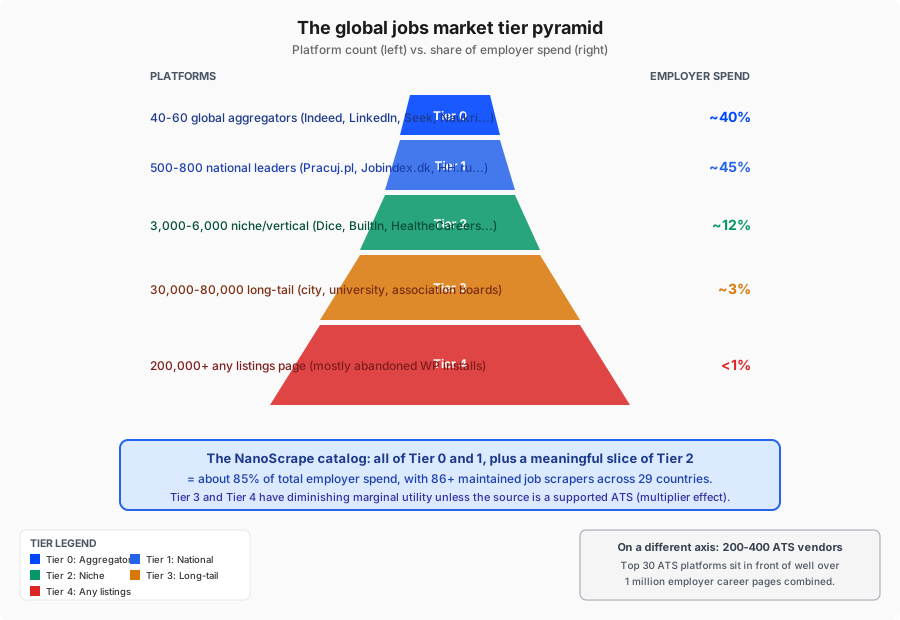
- Tier 0 - Global aggregators and cross-border platforms: about 40 to 60. Indeed, LinkedIn, Seek, Naukri, StepStone, Adzuna, Jooble, Careerjet.
- Tier 1 - National generalist leaders: about 500 to 800. Roughly 120 countries times 3 to 6 leader boards per country. Pracuj.pl in Poland, Jobindex.dk in Denmark, HH.ru in Russia, Karriere.at in Austria.
- Tier 2 - Commercially viable niche and vertical boards: about 3,000 to 6,000. Tech (Dice, BuiltIn, Wellfound), healthcare (HealtheCareers), remote-first (Remotive, WeWorkRemotely), academic (Jobs.ac.uk), nonprofit (CharityJob), sector (Rigzone).
- Tier 3 - Active long-tail: about 30,000 to 80,000. City-specific boards, industry associations, university career pages, chambers of commerce, micro-niches.
- Tier 4 - Anything with a listings page (including stale): 200,000+. WordPress Job Manager installs and no-code board builders account for most of this - six-figure install counts, most abandoned or with single-digit postings.
On top of this taxonomy sits a completely different shape: about 200 to 400 ATS vendors globally, with the top ~30 sitting in front of well over a million employer career pages. That is why the NanoScrape Career Site Jobs Scraper alone touches more employer surface than any 500 Tier-2 job boards combined.
Our maintained catalog covers all of Tier 0 and 1 and a meaningful slice of Tier 2 - 104 shipped job scrapers across 30+ countries and 12 industry verticals. Revenue across the tiers follows a much harder power law than count does: Tier 0 and 1 likely represent 85%+ of total employer spend. Coverage of Tier 3+ has diminishing marginal utility unless the source is an ATS (which multiplies to thousands of endpoints per integration) or a defended DACH incumbent (pricing power). That framing shapes our roadmap.
The 3-tier stack and the Job Feed orchestrator
Beyond the country-specific catalog below, three cross-cutting actors handle careers-page scraping at scale plus a fourth orchestrator that ties everything together:
- Tier 1 - Career Site Jobs Scraper: JSON API access to 24+ ATS platforms (Workday, Phenom, Oracle Recruiting, iCIMS, TalentBrew, Eightfold, Brassring, Avature, Taleo modern, Greenhouse, SmartRecruiters, ADP). HTTP-only, $1 per 1,000 jobs.
- Tier 2 - Website Job Extractor: LLM-powered extraction for any custom careers page. Auto-detects supported ATS platforms on the way in and emits ats_url so the next run can drop to Tier 1 pricing.
- Tier 3 - Website Job Extractor (Browser): Playwright variant for JavaScript-rendered careers pages. Auto-spawned by Tier 2 when needed.
- Job Feed orchestrator (private beta): routes URLs to the right tier, dedupes on job_url, unifies the schema across tiers. Give it a source list, get back one clean dataset.
Which scraper do I need? 4 use cases, 4 tools
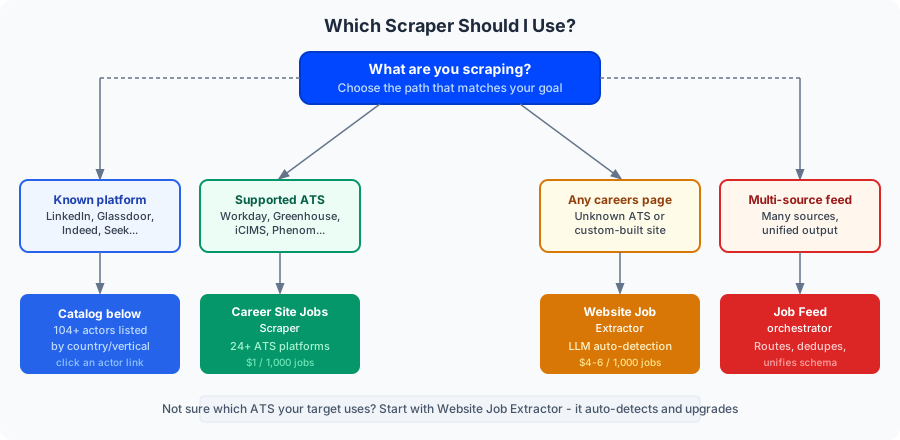
Someone searching for a jobs scraper has one of four underlying needs. Match yours to the right tool:
- Scrape a known platform (Glassdoor, Indeed, Totaljobs, ...): find it in the catalog below, click through, run the actor.
- Scrape a company's careers page on a supported ATS: use Career Site Jobs Scraper. Cheapest option at $1 per 1,000 jobs.
- Scrape any careers page, ATS unknown: use Website Job Extractor. Auto-detects ATS on the way in; falls back to LLM extraction for custom sites.
- Unified multi-source feed at scale: use the Job Feed orchestrator (private beta). Give it a source list, get one clean, deduplicated, schema-unified feed.
Your first run in 5 minutes
The fastest way to see real job data is with the Job Bank Canada Scraper. Job Bank Canada (jobbank.gc.ca) is Canada's official federal government employment board. It has no bot protection, a stable public API, and returns rich structured data including NOC 2021 occupation codes, bilingual flags, hourly wages, and province-level location. It is the ideal starting point for anyone new to the NanoScrape catalog.
Step 1 - Open the actor page
Go to apify.com/santamaria-automations/jobbank-ca-scraper and click Try for free. This opens the Apify Console with a pre-configured input form. You do not need a credit card - the Apify free tier ($5/month) is more than enough for a test run.
Step 2 - Paste the input JSON
Switch the input tab from the visual form to JSON mode and paste the following:
{
  "keywords": "software developer",
  "location": "Ontario",
  "maxItems": 50
}
This searches for software developer roles in Ontario with a limit of 50 results. You can change keywords to any job title and location to any Canadian province or city. Remove location entirely to search across all of Canada.
Step 3 - Click Start and wait
Click Start. The run typically finishes in under 30 seconds for 50 results. When the status indicator turns green, click the Results tab to see your data.
Step 4 - Inspect the output
Each result row is a structured job object. A typical output item looks like this:
[
  {
    "job_url": "https://www.jobbank.gc.ca/jobsearch/jobposting/40812345",
    "title": "Senior Software Developer",
    "company": "Acme Systems Inc.",
    "location": "Toronto, Ontario",
    "salary": "$90,000 to $115,000 per year",
    "employment_type": "Full-time",
    "noc_code": "21232",
    "bilingual": false,
    "posted_date": "2026-08-30",
    "closing_date": "2026-09-20",
    "vacancies": 2,
    "description": "We are looking for a Senior Software Developer to join our platform team..."
  },
  {
    "job_url": "https://www.jobbank.gc.ca/jobsearch/jobposting/40819988",
    "title": "Full Stack Developer",
    "company": "Maple Digital Ltd.",
    "location": "Ottawa, Ontario",
    "salary": "$75,000 to $95,000 per year",
    "employment_type": "Full-time",
    "noc_code": "21232",
    "bilingual": true,
    "posted_date": "2026-08-29",
    "closing_date": "2026-09-15",
    "vacancies": 1,
    "description": "Maple Digital is hiring a Full Stack Developer for our SaaS team..."
  }
]The catalog: 86 job scrapers by country
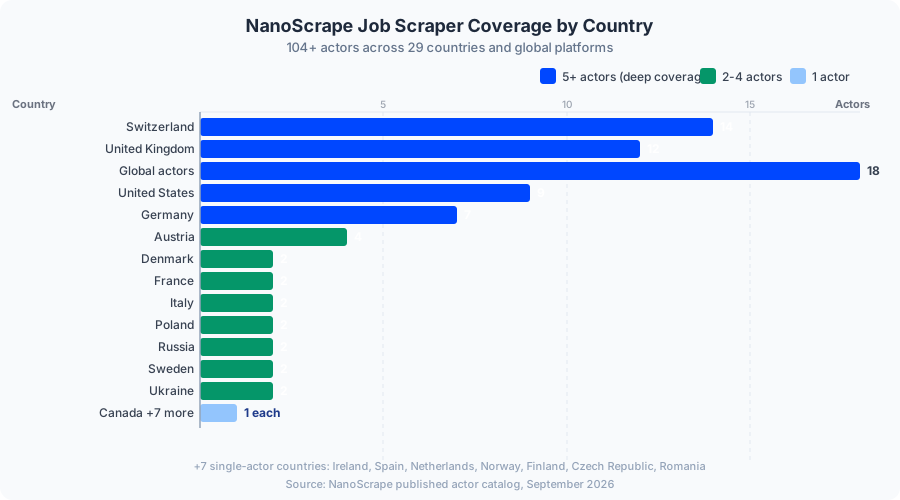
All 86 shipped NanoScrape job scrapers grouped by primary country. Each entry summarizes what's unique about the data. Follow any actor link for the full input schema, output examples, code snippets, and pricing.
United States (9 actors)
- Wellfound Jobs Scraper (Tech): 25+ fields including salary + equity range, tech stack, company stage, funding, and founder info - the richest startup job data on the Apify Store.
- Levels.fyi Scraper (Tech): structured compensation data (base, total comp, equity, bonus) at FAANG-tier companies with role level. Unique compensation-benchmarking data not available elsewhere.
- USAJobs Scraper (Public sector): official US federal job board via public REST API. 30+ fields including GS pay grade, security clearance level, hiring path, and application deadline.
- Craigslist Jobs Scraper (General): 430+ US city subdomains. Extracts salary, contact emails and phones from posting body. Widest local and gig job coverage on the Apify Store.
- Dribbble Jobs Scraper (Tech): the design community's dedicated job board. Returns design category (Product, Brand, Motion), salary, and employment type. Niche coverage for design recruiters.
- Rigzone Scraper (Engineering): 30+ fields for oil, gas and energy jobs including day-rate salary, rig type, rotation, discipline, and certifications. The go-to board for energy sector recruitment.
- Work at a Startup (YC) Jobs Scraper (Tech): Y Combinator's job board. Returns YC batch, equity range, visa sponsorship, founder-replies flag, and tech stack. Unique for YC-backed company hiring signals.
- HealtheCareers Scraper (Healthcare): US healthcare jobs with specialty, subspecialty, credentials (MD/RN/NP/PA), salary min/max, employer type, and shift type. Covers physicians, nurses, allied health, and pharmacy.
- WayUp Scraper (Graduate): internships and entry-level jobs with degree requirement, industry, zip-level location, and degree-level filter. Dedicated early-career source not covered by general boards.
United Kingdom (12 actors)
- Tes.com UK Education Jobs Scraper (Academic research): UK's leading education job board. Teaching stage, subject, ECT suitability, school type, and contract details. Covers UK and international school postings.
- Guardian Jobs Scraper (General): 28+ fields including GBP salary min/max, sector, employer address, and phone. Covers UK charity, media, public sector roles not found on general boards.
- Teaching Vacancies GOV UK Scraper (DfE) (Academic research): official UK DfE board for state schools and academies. Returns phase, key stage, subject, salary scale, and ECT suitability. No alternative on the Apify Store.
- TargetJobs UK Scraper (Graduate): UK graduate jobs, internships, spring weeks, and placement years. Degree requirements, diversity scheme flag, and sector filter. Specialist graduate recruitment board.
- TotalJobs Scraper (General): 30+ fields including salary min/max/currency/period and posting date. High-volume UK job board covering all sectors and regions. Pay-per-result.
- CWJobs UK IT & Tech Jobs Scraper (Tech): specialist UK technology recruitment board since 1993. IR35 status, day rate, contract length, tech skill tags, and sector for IT contract and permanent roles.
- Prospects.ac.uk Scraper (Graduate): official UK universities' careers partner. Degree requirement, visa sponsorship, diversity flags, and closing date across grad schemes, placements, and apprenticeships.
- Jobs.ac.uk Scraper (Academic research): UK academic and research jobs. GBP salary grade band, academic rank, research field, funding source, and PhD studentships. The primary academic job board in the UK.
- JobServe UK Scraper (Tech): UK's oldest IT and engineering board (since 1993). Day rate, IR35 status, contract length, and skills tags. Specialist board for UK tech contractors.
- Escape the City Scraper (Volunteer nonprofit): 30+ fields including B-Corp flag, Top-1% flag, visa-sponsor flag, cause area, and benefits. Unique niche for purpose-driven and ethical employer recruitment.
- CharityJob UK Scraper (Volunteer nonprofit): UK's largest specialist charity job board. Cause area, GBP salary min/max, and closing date. The only dedicated charity job board on the Apify Store.
- Milkround UK Graduate Jobs Scraper (Graduate): UK's dedicated graduate recruitment platform. Degree requirement (2:1/2:2/1st), scheme size, start date type (September intake), and duration for placements and internships.
Canada (1 actor)
- Job Bank Canada Scraper (jobbank.gc.ca) (General): official Canadian federal government job board. NOC 2021 codes, bilingual flag, hourly wages, vacancy count, and all provinces. Stable government source.
Ireland (1 actor)
- IrishJobs.ie Scraper (General): Ireland's largest job board. County-level location, salary, sector, and work type (remote/hybrid/on-site). Primary source for Irish recruitment data.
Germany (7 actors)
- Arbeitsagentur.de Scraper (Government): Germany's official federal employment agency. Salary, full description, and contact details. Covers all German states. Official government source.
- Jobware.de Scraper (General): Germany's premium job portal for professionals. Apply emails, contact persons, salary, and requirements extracted. HTTP-only, fast.
- MeineStadt.de Job Scraper (General): Germany's largest regional job portal with 900K+ listings. Salary ranges, benefits, company logos, and city-radius filter. Best German regional job coverage.
- NiceJob.de Scraper (General): German regional job portal with location, workload, and company type filters. Agency exclusion and optional LLM contact extraction.
- Stellenanzeigen.de Scraper (General): one of Germany's Top 3 job portals. Comprehensive title, salary, requirements, and contact info. Supports direct URL checks and search-based scraping.
- Stellenmarkt.de Scraper (General): established German national job board. Title, salary, requirements, and full descriptions with multi-query search and location filtering.
- StepStone.de Scraper (General): Germany's largest job portal. Salary info, contact details, Bundesland filter, and optional LLM extraction for requirements and benefits. Comprehensive German coverage.
Austria (4 actors)
- Karriere.at Job Scraper (General): Austria's largest private job board. Full Markdown job descriptions, salary, contact details (name, email, phone), and benefits. Pay-per-result.
- StepStone.at Scraper (General): Austria's leading job board covering all 9 Bundesländer. Salary, contact info, and optional LLM-powered data extraction. Multi-source Austrian coverage.
- AMS Austria Scraper (Government): Austria's official public employment service with 100,000+ jobs. Bundesland, employment type, and company details. Official government source.
- Westjob.at Scraper (General): Vorarlberg regional job board. Specialist coverage for Austria's westernmost state. Regional Austrian job market data.
Switzerland (14 actors)
- Arbeit.Swiss Scraper (Government): Switzerland's official public employment service (Job-Room.ch). Canton filter, workload percentage, RAV-registered government listings. Official source.
- ICTjobs.ch Scraper (Tech): Switzerland's dedicated ICT job board. Region, category, employment type, and optional LLM contact extraction. Specialist Swiss tech board.
- JobBasel.ch Scraper (General): Basel and Northwestern Switzerland regional job portal. Workload percentage filter, company type, and optional LLM contact extraction.
- JobBern.ch Scraper (General): Bern region job portal. Workload percentage filter, company type, and optional LLM contact extraction. Specialist regional Swiss coverage.
- JobMittelland.ch Scraper (General): Swiss Mittelland regional job portal covering Solothurn, Olten, and Aarau. Workload filter and optional LLM contact extraction.
- Jobs.ch Scraper (General): Switzerland's largest job board powered by JobCloud. Primary source for Swiss job market data across all industries and cantons.
- JobScout24.ch Scraper (Healthcare): major Swiss job portal with region, category (IT, finance, healthcare), and employment type filters. Optional LLM contact extraction.
- JobZueri.ch Scraper (General): Greater Zurich regional job portal. Workload percentage filter, company type, and optional LLM contact extraction.
- MyJob.ch Scraper (General): Swiss regional job portal. Workload percentage filter, company type, agency exclusion, and optional LLM contact extraction.
- Ostjob.ch Scraper (General): leading portal for Eastern Switzerland (St. Gallen, Thurgau, Appenzell, Graubünden). Canton filter, workload, and optional LLM contact extraction.
- Schaffu.ch Scraper (General): Schaffhausen region job portal. Workload filter, company type, and optional LLM contact extraction. Niche Swiss regional coverage.
- Sozjobs.ch Scraper (Healthcare): leading portal for social work, healthcare, and education jobs in German-speaking Switzerland. Region and contract type filters. Niche specialist coverage.
- SwissDevJobs.ch Scraper (Tech): developer and IT jobs with 25+ technology filters (Python, Go, etc.), visa sponsorship flag, company size, and remote/hybrid options. Built for Swiss tech recruiters.
- Zentraljob.ch Scraper (General): Central Switzerland regional job portal covering Luzern, Zug, Schwyz, and Uri. Workload filter and optional LLM contact extraction.
France (2 actors)
- HelloWork FR Scraper (General): 64M monthly visits. French region and département, contract types (CDI/CDD/Freelance/Alternance/Stage/Intérim), salary, and telework flag. Top French job board coverage.
- France Travail Job Scraper (Government): France's public employment service with 500,000+ active listings. Contract type, salary, and full description. Official French government job source.
Spain (1 actor)
- SEPE Spain Jobs Scraper (Empleate.gob.es) (Public-sector): Spain's national public employment service covering all 17 autonomous communities plus Ceuta and Melilla. Official government source for Spanish job market data.
Italy (2 actors)
- Subito Lavoro Scraper (Jobs): 170,000+ listings from Italy's largest classifieds job section with phone numbers, ISTAT codes, Italian contract types, and optional business seller profiles.
- Subito.it Scraper (Classifieds): Italy's #1 classifieds marketplace with 30M+ monthly visitors. Extracts price, condition, location, seller info, and images across all categories.
Netherlands (1 actor)
- Werk.nl Scraper (Public sector): Netherlands' national government employment service (UWV). Covers all 12 Dutch provinces with title, salary, and employment type. Official government source.
Denmark (2 actors)
- Jobindex.dk Job Scraper (General): Denmark's largest job board. Title, salary, employment type, and full description. Multi-query with deduplication. Essential for Danish market coverage.
- DBA.dk Scraper (Classifieds): Denmark's #1 marketplace (Schibsted). Title, price, GPS coordinates, and images. HTTP-only classified data across all Danish categories.
Sweden (2 actors)
- Arbetsformedlingen Job Scraper (Public sector): Sweden's national employment service via free JobTech API. No authentication required. Official government source for Swedish job listings.
- Blocket.se Scraper (Classifieds): Sweden's #1 marketplace (Schibsted). Title, price, GPS coordinates, and images across all classified categories. HTTP-only.
Norway (1 actor)
- Finn.no Scraper (Jobs+general): Norway's largest marketplace and job board (Schibsted). Covers marketplace, jobs, real estate, and cars across all Norwegian regions. HTTP-only.
Finland (1 actor)
- Oikotie.fi Scraper (General): Finland's largest real estate portal (Sanoma Group) with 55,000+ active listings. Price, rooms, area, coordinates, and building type for buy and rent.
Poland (2 actors)
- Pracuj.pl Job Scraper (General): Poland's #1 job board. PLN salary ranges, company profiles, benefits, and remote filtering. Essential source for Polish labor market data.
- Praca.gov.pl Scraper (Public-sector): Poland's Central Job Offers Database (CBOP) run by the Ministry of Family and Social Policy. CBOP reference numbers, voivodeship, and PUP office details. Official government source.
Czech Republic (1 actor)
- Prace.cz Scraper (General): Czech Republic's largest job board. Czech region, CZK salary, contract type, and experience level. Primary source for Czech labor market intelligence.
Romania (1 actor)
- ANOFM.ro Scraper (Public sector): Romania's National Employment Agency official source. COR occupation codes, Romanian county (județ), salary in RON, and education level for all 41 județe.
Ukraine (2 actors)
- DCZ.gov.ua Scraper (Public sector): Ukraine's State Employment Service registry with 230,000+ active vacancies. Oblast-level coverage, UAH salary, disability/veteran/IDP flags, KATOTTG codes.
- Work.ua Scraper (Jobs): Ukraine's largest private job board with 9M monthly visitors and 106,000+ active vacancies. UAH salary, wartime deferment flag, accessibility flags, and company verified badge.
Russia (2 actors)
- HeadHunter (hh.ru) Scraper (General): Russia's #1 job board via official public REST API. Covers Russia, Kazakhstan, Uzbekistan, Belarus. Salary gross/net flag, metro stations, IT accreditation badge.
- Trudvsem.ru Scraper (Public sector): Russia's official national employment registry via open government API. OKPDTR codes, INN/OGRN, and disability quota flags across all 89 federal subjects.
Global (18 actors)
- Built In Scraper (Tech): US tech jobs across engineering, design, data, product, marketing, and sales. Company logo, work arrangement, and city-level coverage for major US tech hubs.
- Career Site Jobs Scraper (General): extracts jobs from 25+ ATS platforms including Lever, Greenhouse, Workday, Ashby, and Personio. Covers ~60% of Fortune 500 career pages directly.
- Computrabajo Scraper (Aggregator (global)): 40+ fields across 19 LATAM countries. Salary min/max/currency/period, employment type, education, experience years, and skill tags. Best LATAM job board coverage.
- CryptoJobsList Scraper (Engineering / energy): 35 fields including application count, benefits, and company social links. Covers DeFi, engineering, marketing, and non-tech crypto roles.
- Dice Scraper (Tech): 68 fields including company HQ, employee count, industry, and recruiter contacts. 50,000+ tech jobs with skill tags and salary. Most field-rich tech scraper on the Store.
- Glassdoor Scraper (Aggregator (global)): 20+ countries with employer rating, review count, salary estimate flag, and optional employer profile (HQ, size, CEO). Unique review-quality signal alongside job data.
- Idealist Scraper (Nonprofit / impact): 43 fields including areas of focus, organization details, and contact info. 10,000+ social impact positions. Largest nonprofit job dataset on the Apify Store.
- Indeed Scraper Job Board Data Extraction (Aggregator (global)): 60+ countries including Switzerland, Germany, Austria, USA, and UK. Job titles, salaries, and full descriptions. World's largest job board, broad market coverage.
- Jobrapido Scraper (Aggregator (global)): multi-country job aggregator covering Germany, Austria, Switzerland, and 50+ other countries. One actor for broad global recruitment intelligence.
- LinkedIn Company Scraper (Aggregator (global)): employee count, industry, headquarters, description, and specialties. Optional employee profile scraping. Essential for company intelligence and lead generation.
- LinkedIn Jobs Scraper (Remote-first): public LinkedIn job listings. Location, job type, experience level, remote options, company info, and description. No login required.
- Naukri Scraper (Aggregator (global)): 45+ fields including AmbitionBox rating, follower count, founded year, company size, and benefits. Covers India and the Middle East. Most field-rich Indian job scraper.
- Remotive Scraper (Remote-first): 25 fields including salary min/max, skills/tags, company tagline, and all open positions at each company. Dedicated remote job board with rich company data.
- Seek, JobStreet & JobsDB Scraper (Aggregator (global)): 40 fields across 8 countries (AU, NZ, SG, MY, ID, PH, HK, TH). Contact email/phone, work arrangement, and classifications. One actor for all APAC job boards.
- Web3.career Scraper (Remote-first): 25 fields including salary min/max, employment type, industry (Solidity, Rust, DeFi), and expiry date. Covers remote and on-site blockchain roles worldwide.
- Website Job Extractor (HTTP) (General): AI-powered extraction from any company career page. Auto-detects ATS, handles pagination, and validates output. Freshest hiring-intent signal for B2B targeting.
- Welcome to the Jungle Scraper (Aggregator (global)): job title, salary, tech stack, and contract type across France, UK, Germany, Spain, and Czech Republic. Leading European employer-branding job board.
- WeWorkRemotely Scraper (Remote-first): 26 fields including salary min/max, company website, category, and posting date. Covers programming, design, DevOps, marketing, and product remote roles.
Pricing at a glance
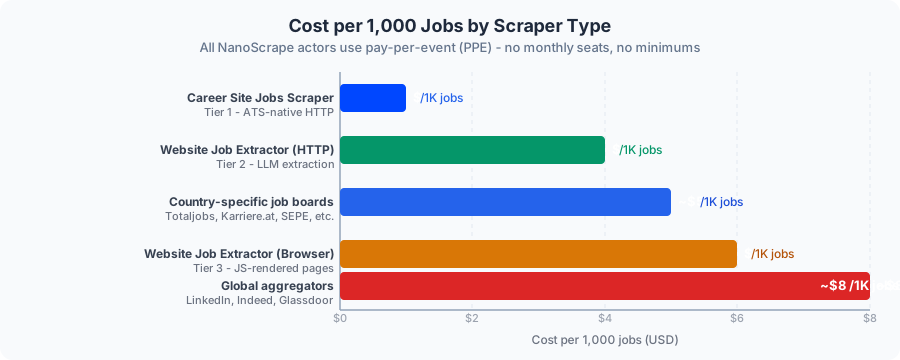
All NanoScrape actors use Apify's pay-per-event (PPE) model. No monthly seats, no minimums. Apify's $5/month free tier covers meaningful testing on any actor.
Get access to Job Feed private beta
The 104+ actors above give you the building blocks. If you want one REST endpoint returning fresh, deduplicated, normalized jobs from every source refreshed daily, that is Job Feed. Currently in private beta while we onboard teams one by one.
- Early API access before public launch.
- Direct input into which platforms get prioritized next.
- Founding-customer pricing locked at beta rates.
- Zero orchestration overhead - send a source list, get a clean dataset.
FAQ
How many job platforms exist worldwide?
Nobody knows exactly. Public directories list under 1,000 boards (Jobboard Finder: 957, JobBoardSearch: 824), but these systematically under-count. Editorial estimates put it above 3,000 active boards. Including city, association, university, and long-tail micro-niches, the total is likely tens of thousands, with 200,000+ if you count anything with a listings page. On a separate axis, roughly 200-400 ATS vendors sit in front of well over a million employer career pages - a much larger surface than any single job board.
Why doesn't your catalog include LinkedIn or Indeed?
It does - see the Global aggregators section. LinkedIn (linkedin-scraper) reads public job data. Indeed (indeed-scraper) is available and returns structured job listings for public queries. Both are subject to platform terms; use responsibly and consult your legal team for scaled commercial use.
Which is cheaper: ATS-native scraping or LLM extraction?
ATS-native (Tier 1: Career Site Jobs Scraper) is 4x cheaper per job than LLM HTTP (Tier 2) and 6x cheaper than Browser (Tier 3). If you know the target company runs a supported ATS, always use Tier 1. If not, let Tier 2 auto-detect and it will emit ats_url so you can switch to Tier 1 on the next run.
Can I run multi-country scraping in one job?
Yes. Multiple actors are inherently multi-country: welcome-to-the-jungle-scraper (FR/UK/DE/ES/CZ), seek-scraper (8 APAC countries), computrabajo-scraper (19 LATAM countries), hh-ru-scraper (RU/KZ/UZ/BY). For broader coverage, run multiple single-country actors in parallel via the Apify API and merge datasets, or use the Job Feed orchestrator for automated routing.
How often is the catalog updated?
We ship approximately 25 new job platform actors per week from our build queue. Published actors appear in this catalog immediately; the build queue file (our internal build queue) tracks shipped-unpublished (in testing) and queued (upcoming). This tutorial regenerates from the same source so new actors show up on the next deploy.
Related resources
- How to Scrape Every Fortune 500 Job Listing: Full technical playbook: ATS distribution, input examples, output schemas, mapper script, cost math.
- Fortune 500 ATS Market Share 2026: Data study of ATS platforms across the F500. Workday leads with 118 deployments.
- How to Scrape Workday Jobs: Deep dive on Workday: 118 F500 companies + API pattern + ready-to-run input.
- Job Feed private beta landing page: The orchestrator that ties the 3-tier stack into a unified, daily-refreshed jobs feed.
- All NanoScrape tutorials: Step-by-step guides for every actor in the catalog.